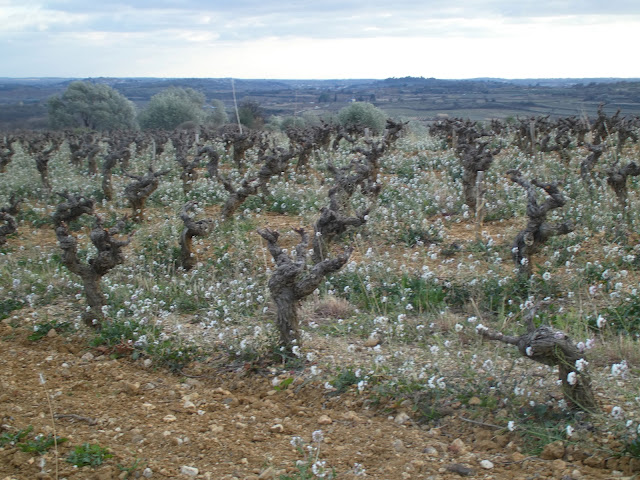
To continue with Roussillon, a great range from Mas Amiel, as always. It fully deserves its reputation as one of the leading producers of Maury.
2009 Plaisir Blanc, Côtes du Roussillon
A blend of 45% Grenache Blanc, 30% Maccabeu and 15% each of Marsanne and Roussanne.
Quite solid, rich and rounded, with a slightly resinous note on both nose and palate. Layers of flavours. Potential to develop in the bottle.
2008 Côtes du Roussillon Villages, Notre Terre. 13€
One third each of Syrah, Carignan and Grenache. The Syrah and Carignan are fermented in wood, and then blended with the Grenache, and aged in concrete tanks. Lovely ripe fruit. Ripe and spicy with a fresh edge. Rich and elegant. Wonderfully southern.
And then on to the Vins Doux:
2009 Maury Vintage – their best known wine. – 15.50€
Grenache aged for a few months in concrete tanks and then bottled. Intense ripe fruit on the nose. Rich cherry flavours; red fruit and chocolate. Quite intense. Rich and spicy with length, and some alcohol on the finish.
2007 Maury, Charles Dupuy – 32€
Named after the man who established the original reputation of Mas Amiel, when it was the only estate of any note in Maury. A selection of the oldest vines, Grenache that are 50 years old and more. Bottled in 2009. The élevage includes a few months in wood. Much richer and more concentrated on the palate, with a dry edge on the finish. I preferred the simpler wine.
But best of all was 1975 Maury – 50€
The traditional rancio style, Red tawny colour. Rich nutty, with some red fruit and an edge of acidity and a steak of tannin. Still remarkably young. Powerful and elegant. Lots of nuances and complexity. Combines power and elegance. Classic Maury and absolutely delicious.
And to finish. 2009 Muscat de Rivesaltes, a blend of both Muscat a petits grains and Muscat d’Alexandrie. 13€
Ripe and sweet, grapey fruit and the typical slightly bitter finish of Muscat.
Thursday, 2 February 2012
Wednesday, 1 February 2012
DOMAINE MASTRIO
Another new estate in Roussillon, in Ille sur Tet, within Côtes du Roussillon Caramany. I talked to Caty Dhoine Paetzold; she is Belgian and her husband comes from Germany. They made their first wine, just 1000 bottles in 2006 and have 20 hectares. Caty admitted that their yields are miniscule, 15 hl/ha. And their vines range in age from 25 to 102 years old.
We began with a rosé, 2010 Libertine – 11€ - made from Carignan, from grapes that are pressed. Pale orange pink colour. Very ripe and vinous. Quite a heavy food rosé. And quite mouth filling.
2008 Côtes du Roussillon Villages, Dynamique 11€ A blend of 60 % Syrah with Carignan. Made in vat. Medium colour. Quite ripe nose, with some warm spicy fruit on the palate. Balanced with some ripe leathery notes. Warm and supple, with notes of the garrigues on the finish. A lovely glass of wine.
2007 Côtes du Roussillon Villages Généreux– 17€
A blend of Syrah, Grenache and Carignan- about one third each, which spends 12 months in wood. Their first real vintage. I liked this less, the palate was quite solid and firm. I felt it was work in progress.
I much preferred 2007 Elégant, a pure Carignan It spent twelve months in oak, but from 2008, there was no more oak. Quite ripe and solid on the nose. A rounded palate; the oak was well integrated, with some ripe spicy fruit. Good body.
2009 Pain d’Oiseau Côtes Catalanes. Carignan blanc from vines that are between 60 and 120 years old. Élevage in vat. Quite rounded, ripe and textured. Almost nutty with ripe fruit. Very satisfying.
Again a new estate with considerable potential.
We began with a rosé, 2010 Libertine – 11€ - made from Carignan, from grapes that are pressed. Pale orange pink colour. Very ripe and vinous. Quite a heavy food rosé. And quite mouth filling.
2008 Côtes du Roussillon Villages, Dynamique 11€ A blend of 60 % Syrah with Carignan. Made in vat. Medium colour. Quite ripe nose, with some warm spicy fruit on the palate. Balanced with some ripe leathery notes. Warm and supple, with notes of the garrigues on the finish. A lovely glass of wine.
2007 Côtes du Roussillon Villages Généreux– 17€
A blend of Syrah, Grenache and Carignan- about one third each, which spends 12 months in wood. Their first real vintage. I liked this less, the palate was quite solid and firm. I felt it was work in progress.
I much preferred 2007 Elégant, a pure Carignan It spent twelve months in oak, but from 2008, there was no more oak. Quite ripe and solid on the nose. A rounded palate; the oak was well integrated, with some ripe spicy fruit. Good body.
2009 Pain d’Oiseau Côtes Catalanes. Carignan blanc from vines that are between 60 and 120 years old. Élevage in vat. Quite rounded, ripe and textured. Almost nutty with ripe fruit. Very satisfying.
Again a new estate with considerable potential.
DOMAINE DE SABBAT
A new estate in Roussillon, in the village of Latour de France. Sylvain Lejeune has bought nine hectares, and made his first wines in 2009. His vines are anything between 40 and 80 years old.
2010 Côtes du Roussillon – A blend of Grenache Gris, Grenache Blanc and Maccabeu, fermented in oak. The oak is still quite dominant on the nose, with a rounded oaky palate. A textured wine with lots of development potential and a long finish.
2010 Côtes du Roussillon Villages – 80% Carignan, with Syrah, and unusual for not having any Grenache. Spends four months in wood. Quite a firm peppery nose with some spicy fruit on the palate. Quite a firm oaky streak. The Syrah tempers the Carignan
2009 Côtes du Roussillon Villages, Printemps 1900
A blend of 60% Syrah with 40% Syrah. Spends 12 months in tonneaux. Quite a solid rounded mouthful of wine. Youthful and ripe with good texture. Full-bodied. A long rich finish. A touch of alcohol on the finish. Redolent of the warm south.
2010 Rivesaltes Grenat – pure Grenache Noir. Quite a deep colour. Quite ripe and rounded. Quite intensely sweet, rich and ripe, balanced with a youthful tannic streak.
On first taste, lots of potential and worth a visit.
2010 Côtes du Roussillon – A blend of Grenache Gris, Grenache Blanc and Maccabeu, fermented in oak. The oak is still quite dominant on the nose, with a rounded oaky palate. A textured wine with lots of development potential and a long finish.
2010 Côtes du Roussillon Villages – 80% Carignan, with Syrah, and unusual for not having any Grenache. Spends four months in wood. Quite a firm peppery nose with some spicy fruit on the palate. Quite a firm oaky streak. The Syrah tempers the Carignan
2009 Côtes du Roussillon Villages, Printemps 1900
A blend of 60% Syrah with 40% Syrah. Spends 12 months in tonneaux. Quite a solid rounded mouthful of wine. Youthful and ripe with good texture. Full-bodied. A long rich finish. A touch of alcohol on the finish. Redolent of the warm south.
2010 Rivesaltes Grenat – pure Grenache Noir. Quite a deep colour. Quite ripe and rounded. Quite intensely sweet, rich and ripe, balanced with a youthful tannic streak.
On first taste, lots of potential and worth a visit.
Monday, 30 January 2012
DOMAINE LA COUME DU ROY
A familiar name, as they were showing a couple of wines on the Maury walk last May. Agnès de Volantat –Bachelet explained that 75% of her vineyards are Grenache, with some Carignan, Syrah and Mourvèdre. And she also has some Muscat. And 2011 is the first vintage for Maury Sec, with about ten producers of a red table wine, and only red, to distinguish it from the surrounding Côtes du Roussillon Villages. Maury as Vin Doux can be white as well as red.
2007 Côtes du Roussillon Villages, Désir, a blend of Grenache and Syrah. – a future Maury Sec
Good colour; solid rounded ripe fruit, a touch oak, nicely full-bodied.
2010 Maury Traditionnel, from Grenache
Some spicy red fruit. Quite ripe, rounded spice on the palate. Well integrated alcohol. The alcohol is added to the juice.
2009 Maury Vintage
Again pure Grenache. Very deep colour. Youthful spice, medium weight palate, riper, more tannic with more concentration. The difference between mutage on juice, as in the previous wine, and mutage on skins, as for this wine, with three weeks skin contact with the alcohol. Lovely youthful spice.
Maury Blanc, again from Grenache, Blanc and Gris. Quite ripe and rounded, with juicy ripe fruit on the palate, with good acidity, some alcohol and a raisiny finish. 13.00€
1925 Maury Blanc, or rather tawny brown in colour. It was bottled in 2001, a foudre made by Agnès’ great grandfather, and a piece of history. Lovely ripe rich fruit, long lingering rich palate with a long elegant finish. Absolutely delicious. Elegantly dry, rich and nutty. Only 3000 bottles made – 350€
2010 Muscat de Rivesaltes, a blend of both Muscat à petits grains and Muscat d’Alexandrie. – Half and half. Fresh, ripe and grapey with a bitter Muscat finish. Classic.
2007 Côtes du Roussillon Villages, Désir, a blend of Grenache and Syrah. – a future Maury Sec
Good colour; solid rounded ripe fruit, a touch oak, nicely full-bodied.
2010 Maury Traditionnel, from Grenache
Some spicy red fruit. Quite ripe, rounded spice on the palate. Well integrated alcohol. The alcohol is added to the juice.
2009 Maury Vintage
Again pure Grenache. Very deep colour. Youthful spice, medium weight palate, riper, more tannic with more concentration. The difference between mutage on juice, as in the previous wine, and mutage on skins, as for this wine, with three weeks skin contact with the alcohol. Lovely youthful spice.
Maury Blanc, again from Grenache, Blanc and Gris. Quite ripe and rounded, with juicy ripe fruit on the palate, with good acidity, some alcohol and a raisiny finish. 13.00€
1925 Maury Blanc, or rather tawny brown in colour. It was bottled in 2001, a foudre made by Agnès’ great grandfather, and a piece of history. Lovely ripe rich fruit, long lingering rich palate with a long elegant finish. Absolutely delicious. Elegantly dry, rich and nutty. Only 3000 bottles made – 350€
2010 Muscat de Rivesaltes, a blend of both Muscat à petits grains and Muscat d’Alexandrie. – Half and half. Fresh, ripe and grapey with a bitter Muscat finish. Classic.
Friday, 27 January 2012
SALON DES VIGNERONS INDEPENDENTS IN LONDON - Domaine du Grand Chemin
I didn’t get to the Salon des Vignerons Independents in Paris this winter, for various reasons, but instead made up for that omission at a mini-salon at Lords last week. There was a good handful of growers from Languedoc-Roussillon, some new to me and some familiar. So my next few posts will focus on what I discovered at Lords.
First off was a new name – Domaine du Grand Chemin, with Emmanuel Floutier, at Savinargues in the Gard, not too far from Anduze and Alès. Most of the wines they were showing were IGP Pays d’Oc, but they also come within the Pays des Cevennes and Duché d’Uzès. Emmanuel’s first bottling was the 2003 vintage, but his father started bottling back in 1984. Altogether they have 60 hectares of vines and produce an eclectic range. Here are some of the highlights, or indeed just of few of the wines they make, as the number of wines was limited to six for each exhibitor – nowhere near enough, even with a couple more hidden under the table. I ended up tasting more of their wines that I anticipated which must be a good thing.
2011 Sauvignon – 4.50€
Quite a firm pithy nose. Crisp palate, with good acidity and a rounded finish.
2011 Viognier
A hint peachy on both nose and palate. No great depth but fresh with light varietal character.
2011 Chardonnay
Lightly buttery on the nose. Light fruit on the palate and nicely balanced.
2011 Rosé Gris – a blend of Cinsaut and Grenache. – 4.60€
This wine accounts for 40% of their production, and pretty good it was too. A light, pretty colour. A delicate nose, but on the palate quite ripe and vinous, with a rounded delicate fruity finish. A food rosé.
2010 Pinot Noir
They are in one of the cooler parts of the Languedoc, where Pinot Noir fares better. It was quite a simple wine, but none the worse for that. A delicate nose, with a hint of raspberry, and on the palate quite dry, with a hint of liquorice and a fresh finish. Easy simple drinking.
2010 Merlot
Quite ripe and rounded, with a tannic streak.
2009 Cabernet Sauvignon.
Quite rich, rounded cassis on the nose. Quite dry fruit on the palate, with good varietal character.
And then came a couple of blends:
2009 Cuvée JMF – after Emmanuel’s father Jean-Marc. -9.00€ A blend of 80% Cabernet Sauvignon with 20% Pinot Noir, blended together after six months of élevage, partly in old French oak and partly in vat. The nose was quite firm and oaky, with some perfumed fruit on the palate, some spicy oak and a fresh finish. I am not sure about blending Cabernet Sauvignon and Pinot Noir – I think they might argue a bit in the glass, but from memory it was the first time that I had tasted such a blend.
2010 Clos Rogé, a blend of 40% each of Syrah and Cabernet Sauvignon, with 20% Petit Verdot which worked better. It was also more expensive at 14.50€ and included a higher percentage (80%) of oak ageing, in 400 litre tonneaux.. Quite firm and structured on the nose; quite powerful palate, with an elegant finish. Some good ageing potential.
www.domainedugrandchemin.com
First off was a new name – Domaine du Grand Chemin, with Emmanuel Floutier, at Savinargues in the Gard, not too far from Anduze and Alès. Most of the wines they were showing were IGP Pays d’Oc, but they also come within the Pays des Cevennes and Duché d’Uzès. Emmanuel’s first bottling was the 2003 vintage, but his father started bottling back in 1984. Altogether they have 60 hectares of vines and produce an eclectic range. Here are some of the highlights, or indeed just of few of the wines they make, as the number of wines was limited to six for each exhibitor – nowhere near enough, even with a couple more hidden under the table. I ended up tasting more of their wines that I anticipated which must be a good thing.
2011 Sauvignon – 4.50€
Quite a firm pithy nose. Crisp palate, with good acidity and a rounded finish.
2011 Viognier
A hint peachy on both nose and palate. No great depth but fresh with light varietal character.
2011 Chardonnay
Lightly buttery on the nose. Light fruit on the palate and nicely balanced.
2011 Rosé Gris – a blend of Cinsaut and Grenache. – 4.60€
This wine accounts for 40% of their production, and pretty good it was too. A light, pretty colour. A delicate nose, but on the palate quite ripe and vinous, with a rounded delicate fruity finish. A food rosé.
2010 Pinot Noir
They are in one of the cooler parts of the Languedoc, where Pinot Noir fares better. It was quite a simple wine, but none the worse for that. A delicate nose, with a hint of raspberry, and on the palate quite dry, with a hint of liquorice and a fresh finish. Easy simple drinking.
2010 Merlot
Quite ripe and rounded, with a tannic streak.
2009 Cabernet Sauvignon.
Quite rich, rounded cassis on the nose. Quite dry fruit on the palate, with good varietal character.
And then came a couple of blends:
2009 Cuvée JMF – after Emmanuel’s father Jean-Marc. -9.00€ A blend of 80% Cabernet Sauvignon with 20% Pinot Noir, blended together after six months of élevage, partly in old French oak and partly in vat. The nose was quite firm and oaky, with some perfumed fruit on the palate, some spicy oak and a fresh finish. I am not sure about blending Cabernet Sauvignon and Pinot Noir – I think they might argue a bit in the glass, but from memory it was the first time that I had tasted such a blend.
2010 Clos Rogé, a blend of 40% each of Syrah and Cabernet Sauvignon, with 20% Petit Verdot which worked better. It was also more expensive at 14.50€ and included a higher percentage (80%) of oak ageing, in 400 litre tonneaux.. Quite firm and structured on the nose; quite powerful palate, with an elegant finish. Some good ageing potential.
www.domainedugrandchemin.com
Sunday, 22 January 2012
THIS AND THAT AT LIBERTY WINES
Liberty Wines celebrated their 15th anniversary this week with a mega tasting at the Oval Cricket ground. In my mind, they are known above all for what was a ground-breaking range of Italian, and especially Tuscan wine, when they first started up, but these days their list covers the world and includes some stars from the Languedoc, namely:
2011 Château la Tour de Bérard, Costières de Nîmes blanc
This is the sister property of the better known Château Mourgues de Grès. A blend of 40% Grenache Blanc with 30% each of Roussanne and Vermentino. Still very young with some pithy fruit with hints of white blossom and some good acidity. Nicely understated and plenty of potential for further development.
2010 Château la Tour de Bérard, Costières de Nîmes rouge
A blend of Syrah and Grenache, with some Mourvèdre and Carignan. Quite a deep colour. Very perfumed sunny fruit. Rounded ripe and spicy, with supple tannins. Lovely easy drinking.
2011 Domaine la Croix Gratiot, Picpoul de Pinet.
Quite a fresh stony nose, but more rounded and perfumed on the palate. Not the saline minerality that I expect for Picpoul or whether that will develop with a bit more bottle age. A slightly sweet finish.
There was also a 2011 Roussanne, IGP Pays d’Oc
Quit rounded, with white flowers and some perfume and a dry finish. Very pleasant easy drinking.
There were a couple of wines from Mas la Chevalière, the Domaine Laroche property outside Beziers. 2010 Chardonnay was a tank sample and was quite fresh without much real character. Nor was the 2010 Viognier particularly expressive. More satisfying was 2008 Vignoble Peyral, a blend of 85% Chardonnay and 15% Viognier, grown in vineyards at 200 metres. Quite solid, rounded and nutty, with a peachy hint from the Viognier.
Emmanuel Cazes, from Domaine Cazes in Rivesaltes, was at the tasting with a couple of wines:
2011 Le Canon du Maréchal Blanc, a blend of Muscat with 20% Viognier. Lovely grapey varietal character. Very Muscat, but with the potential bitterness of the Muscat on the finish softened by the peachiness of the Viognier. Easy drinking for an apéro.
2010 Marie Gabrielle, Côtes du Roussillon
60% Syrah, with 40% Grenache. Quite rounded and ripe, with a leathery tannic note. Ripe and spicy with a firm finish. Youthful, characterful and satisfying.
2009 Château Saint Roch, Chimères, Côtes du Roussillon Villages
Quite firm with some leathery fruit and some oak on the palate, which slightly overwhelms the fruit. I preferred the Cazes wine.
However, the real surprise of the tasting was the very first wine I have ever tasted from Armenia. Estate name Zorah, made by Zorik Gharibian with the help of Italian oenologist Alberto Antonini. The grape is an indigenous variety, Areni. No, I had never heard of it either. It is ungrafted – there is no phylloxera in the southern part of Armenia. The wine fermented in stainless steel and then undergoes a malo-lactic fermentation, partly in amphora – the mention karasi on the label indicates this – and also in French and Armenian oak. Armenian oak is apparently denser than French oak. And how did it taste? I had no idea what to expect. Elegance was the dominant characteristic; medium colour; quite a firm nose. Cherry fruit – not so dissimilar to Sangiovese, with a streak of tannin and freshness on the finish. A really lovely surprise.
The other extreme at the tasting were wines from England – a couple of sparkling wines from new producers Coates & Seely a blanc de blancs from Chardonnay and a rosé, with some ripe fruit. And then I spotted two wines from Stopham in West Sussex. This is a village that I associate with brass-rubbing in the church more years ago than I care to remember. Simon Woodhead was showing a Pinot Blanc and a Pinot Gris – I had no idea that these were planted anywhere near the South Downs. The 2010 Pinot Blanc was light and delicate with some fresh fruit, and while the 2010 Pinot Gris had a touch of residual sugar to round it out a bit, balanced with some spice and good acidity.
And to complete the unexpected flavours of the day, friends came to dinner bearing a bottle that their son-in-law had procured in the duty free shop at Adis Abeba airport – yes, it was an Ethiopian wine. A dry white wine, labelled Awash Cristal, from a possible appropriately named producer, Awash Wineries. The back label gave no clues about grape varieties, simply saying that it is ‘made from early grapes and produced with particular methods’. It would be kind to say that it was short on flavour – but it got full marks for originality of provenance.
2011 Château la Tour de Bérard, Costières de Nîmes blanc
This is the sister property of the better known Château Mourgues de Grès. A blend of 40% Grenache Blanc with 30% each of Roussanne and Vermentino. Still very young with some pithy fruit with hints of white blossom and some good acidity. Nicely understated and plenty of potential for further development.
2010 Château la Tour de Bérard, Costières de Nîmes rouge
A blend of Syrah and Grenache, with some Mourvèdre and Carignan. Quite a deep colour. Very perfumed sunny fruit. Rounded ripe and spicy, with supple tannins. Lovely easy drinking.
2011 Domaine la Croix Gratiot, Picpoul de Pinet.
Quite a fresh stony nose, but more rounded and perfumed on the palate. Not the saline minerality that I expect for Picpoul or whether that will develop with a bit more bottle age. A slightly sweet finish.
There was also a 2011 Roussanne, IGP Pays d’Oc
Quit rounded, with white flowers and some perfume and a dry finish. Very pleasant easy drinking.
There were a couple of wines from Mas la Chevalière, the Domaine Laroche property outside Beziers. 2010 Chardonnay was a tank sample and was quite fresh without much real character. Nor was the 2010 Viognier particularly expressive. More satisfying was 2008 Vignoble Peyral, a blend of 85% Chardonnay and 15% Viognier, grown in vineyards at 200 metres. Quite solid, rounded and nutty, with a peachy hint from the Viognier.
Emmanuel Cazes, from Domaine Cazes in Rivesaltes, was at the tasting with a couple of wines:
2011 Le Canon du Maréchal Blanc, a blend of Muscat with 20% Viognier. Lovely grapey varietal character. Very Muscat, but with the potential bitterness of the Muscat on the finish softened by the peachiness of the Viognier. Easy drinking for an apéro.
2010 Marie Gabrielle, Côtes du Roussillon
60% Syrah, with 40% Grenache. Quite rounded and ripe, with a leathery tannic note. Ripe and spicy with a firm finish. Youthful, characterful and satisfying.
2009 Château Saint Roch, Chimères, Côtes du Roussillon Villages
Quite firm with some leathery fruit and some oak on the palate, which slightly overwhelms the fruit. I preferred the Cazes wine.
However, the real surprise of the tasting was the very first wine I have ever tasted from Armenia. Estate name Zorah, made by Zorik Gharibian with the help of Italian oenologist Alberto Antonini. The grape is an indigenous variety, Areni. No, I had never heard of it either. It is ungrafted – there is no phylloxera in the southern part of Armenia. The wine fermented in stainless steel and then undergoes a malo-lactic fermentation, partly in amphora – the mention karasi on the label indicates this – and also in French and Armenian oak. Armenian oak is apparently denser than French oak. And how did it taste? I had no idea what to expect. Elegance was the dominant characteristic; medium colour; quite a firm nose. Cherry fruit – not so dissimilar to Sangiovese, with a streak of tannin and freshness on the finish. A really lovely surprise.
The other extreme at the tasting were wines from England – a couple of sparkling wines from new producers Coates & Seely a blanc de blancs from Chardonnay and a rosé, with some ripe fruit. And then I spotted two wines from Stopham in West Sussex. This is a village that I associate with brass-rubbing in the church more years ago than I care to remember. Simon Woodhead was showing a Pinot Blanc and a Pinot Gris – I had no idea that these were planted anywhere near the South Downs. The 2010 Pinot Blanc was light and delicate with some fresh fruit, and while the 2010 Pinot Gris had a touch of residual sugar to round it out a bit, balanced with some spice and good acidity.
And to complete the unexpected flavours of the day, friends came to dinner bearing a bottle that their son-in-law had procured in the duty free shop at Adis Abeba airport – yes, it was an Ethiopian wine. A dry white wine, labelled Awash Cristal, from a possible appropriately named producer, Awash Wineries. The back label gave no clues about grape varieties, simply saying that it is ‘made from early grapes and produced with particular methods’. It would be kind to say that it was short on flavour – but it got full marks for originality of provenance.
Thursday, 12 January 2012
TEN DAYS IN THE LANGUEDOC
Ten days in the Languedoc, and not one cellar visit ....... but some highlights around a table. Vigneron friends came to dinner, but mainly English with a thirst for New Zealand. And French friends were introduced to the delights of English bubbles. Ridgeview’s Grosvenor came up trumps.
Dinner with my tasting buddy Lits, who produced both red and white from Finca Narraza in St. Paul de Fenouillet - new name for me, and definitely worth exploring further.
The 2006 white is a blend of Grenache Gris, Grenache Blanc and Macabeo, Camps del Roi, Côtes Catalanes. A light amber colour, with a rich nutty nose and palate. Initially it might seem oxidised, but it is most definitely not. A wine with great depth, character, richness and length. Very good acidity.
The red was also from the 2006 vintage, les Cigales, Côtes du Roussillon Villages a blend of Grenache, Carignan and Syrah. Deep young colour. Quite rich and intense on the nose, with ripe fruit on the palate. Quite tannic with a mineral streak. Again very intriguing with length and depth.
Friends from the village came to dinner and Françoise Ollier’s 2010 les Collines slipped own a treat – sunshine in a glass; with ripe spicy fruit. And Lizzie came bearing a bottle of 2004 No 7 from Domaine la Croix Belle. I admit to my shame that I omitted to write a tasting note sat the time, but from memory, it was drinking beautifully; any oak had long since integrated leaving a wonderful complete, harmonious glass of wine.
And the next evening a friend generously opened bottles of 2007 Mas de Daumas Gassac. It was sound, with firm tannins and firm fruit, but it simply did not sing, and I did not feel that it was going anywhere either. A bottle of the 2000 vintage drunk in London last autumn was so much better.
Dinner with Anne and Christian at Domaine de Monplézy, with fellow guests Deborah and Peter from Mas Gabriel, confirmed just how much I enjoy the wines from both estates – see earlier postings. And Christian is a dab hand with barbecued gigot d’agneau.
And before we rushed to the airport we checked out the new restaurant in our village, Le Petit Péché. It has to be said that the wine list needs a bit of work, but it did produce a cheerful 2010 Muscat Sec, Côtes de Thongue from Domaine Bonian. Light colour; ripe, grapey, pithy Muscat fruit, and fresh varietal character on the palate, with a sweet touch of grapy fruit and a slightly bitter Muscat finish. Very Muscat.
And the red wine was 2010 l’Ambrin Vin de la Grange, Languedoc, a blend of Syrah and Grenache – see my earlier posting about Eric Morot’s wines. This was quite solid on the nose, with rustic peppery black fruit on the palate. And went deliciously with a confit de canard.
And now I am off to taste some 2010 Chablis for a complete change of flavours.
Dinner with my tasting buddy Lits, who produced both red and white from Finca Narraza in St. Paul de Fenouillet - new name for me, and definitely worth exploring further.
The 2006 white is a blend of Grenache Gris, Grenache Blanc and Macabeo, Camps del Roi, Côtes Catalanes. A light amber colour, with a rich nutty nose and palate. Initially it might seem oxidised, but it is most definitely not. A wine with great depth, character, richness and length. Very good acidity.
The red was also from the 2006 vintage, les Cigales, Côtes du Roussillon Villages a blend of Grenache, Carignan and Syrah. Deep young colour. Quite rich and intense on the nose, with ripe fruit on the palate. Quite tannic with a mineral streak. Again very intriguing with length and depth.
Friends from the village came to dinner and Françoise Ollier’s 2010 les Collines slipped own a treat – sunshine in a glass; with ripe spicy fruit. And Lizzie came bearing a bottle of 2004 No 7 from Domaine la Croix Belle. I admit to my shame that I omitted to write a tasting note sat the time, but from memory, it was drinking beautifully; any oak had long since integrated leaving a wonderful complete, harmonious glass of wine.
And the next evening a friend generously opened bottles of 2007 Mas de Daumas Gassac. It was sound, with firm tannins and firm fruit, but it simply did not sing, and I did not feel that it was going anywhere either. A bottle of the 2000 vintage drunk in London last autumn was so much better.
Dinner with Anne and Christian at Domaine de Monplézy, with fellow guests Deborah and Peter from Mas Gabriel, confirmed just how much I enjoy the wines from both estates – see earlier postings. And Christian is a dab hand with barbecued gigot d’agneau.
And before we rushed to the airport we checked out the new restaurant in our village, Le Petit Péché. It has to be said that the wine list needs a bit of work, but it did produce a cheerful 2010 Muscat Sec, Côtes de Thongue from Domaine Bonian. Light colour; ripe, grapey, pithy Muscat fruit, and fresh varietal character on the palate, with a sweet touch of grapy fruit and a slightly bitter Muscat finish. Very Muscat.
And the red wine was 2010 l’Ambrin Vin de la Grange, Languedoc, a blend of Syrah and Grenache – see my earlier posting about Eric Morot’s wines. This was quite solid on the nose, with rustic peppery black fruit on the palate. And went deliciously with a confit de canard.
And now I am off to taste some 2010 Chablis for a complete change of flavours.
Saturday, 31 December 2011
BACK IN THE LANGUEDOC
The first evening in our Languedoc home for three months and friends coming to dinner – so a good opportunity to open a bottle or two.
First was Villa Dondona’s 2010 Esperel,Coteaux du Languedoc Blanc, a blend of Vermentino and Grenache Blanc with a touch of Marsanne and Roussanne. Light colour, with some herbal notes on the nose. Some white blossom and a herbal note on the palate, balanced with refreshing acidity. Nicely understated. It made a good apéro. I first tried this in the spring when it won a trophy in the Vallée de l’Hérault competition and it was gratifying to find it just as good nine months on.
Next came 2009 Les Clauzes de Jo from Domaine des Belles Pierres. Damien Coste is a particularly talented white winemaker. And this was delicious, with a light colour and a slightly honeyed note on the nose. There was more honey on the palate, with a ripe flavour and a satisfying mouth feel, balanced with good acidity and a rounded finish. A blend of Roussanne, Grenache Blanc and Viognier.
And then we compared a pair of Carignan. First was 2009 Vieux Carignan, Cuvée Paul from Mas d’Amile in Montpeyroux, so an IGP Mont Baudile. Medium young colour. Some berry fruit on the nose, and even more on the palate with a streak of tannin. An elegant edge of rusticity. Nicely balanced fruit and tannins. Still quite youthful but drinking well now.
2004 Carignan from Jean-Louis Denois in Limoux, so a more mature wine from cooler vineyards. Medium colour. Quite a dry leathery quality on the nose, and also on the palate, with some dry fruit. A certain sturdy quality; a more masculine wine than Mas d’Amile. Quite rustic with dry warmth and very satisfying.
So two shining examples of the dramatic improvement in white wine making in the Languedoc, and two lovely examples of a once despised grape variety.
And for a quiet ‘this is not a New Year’s Eve dinner’, I am contemplating a bottle of Crémant de Limoux Rosé from Domaine Rives Blanques, and a bottle of Domaine de Clovallon’s best Pinot Noir, 2006 les Pomarèdes to accompany a guinea fowl.
Bonne Année to all lovers of Languedoc wines!
First was Villa Dondona’s 2010 Esperel,Coteaux du Languedoc Blanc, a blend of Vermentino and Grenache Blanc with a touch of Marsanne and Roussanne. Light colour, with some herbal notes on the nose. Some white blossom and a herbal note on the palate, balanced with refreshing acidity. Nicely understated. It made a good apéro. I first tried this in the spring when it won a trophy in the Vallée de l’Hérault competition and it was gratifying to find it just as good nine months on.
Next came 2009 Les Clauzes de Jo from Domaine des Belles Pierres. Damien Coste is a particularly talented white winemaker. And this was delicious, with a light colour and a slightly honeyed note on the nose. There was more honey on the palate, with a ripe flavour and a satisfying mouth feel, balanced with good acidity and a rounded finish. A blend of Roussanne, Grenache Blanc and Viognier.
And then we compared a pair of Carignan. First was 2009 Vieux Carignan, Cuvée Paul from Mas d’Amile in Montpeyroux, so an IGP Mont Baudile. Medium young colour. Some berry fruit on the nose, and even more on the palate with a streak of tannin. An elegant edge of rusticity. Nicely balanced fruit and tannins. Still quite youthful but drinking well now.
2004 Carignan from Jean-Louis Denois in Limoux, so a more mature wine from cooler vineyards. Medium colour. Quite a dry leathery quality on the nose, and also on the palate, with some dry fruit. A certain sturdy quality; a more masculine wine than Mas d’Amile. Quite rustic with dry warmth and very satisfying.
So two shining examples of the dramatic improvement in white wine making in the Languedoc, and two lovely examples of a once despised grape variety.
And for a quiet ‘this is not a New Year’s Eve dinner’, I am contemplating a bottle of Crémant de Limoux Rosé from Domaine Rives Blanques, and a bottle of Domaine de Clovallon’s best Pinot Noir, 2006 les Pomarèdes to accompany a guinea fowl.
Bonne Année to all lovers of Languedoc wines!
Wednesday, 21 December 2011
MAS GABRIEL at the Solicitors' Wine Society
Christmas deadlines seem to have taken over and I’ve neglected my blog for the last week or three - apologies – I’m not sure where the days have gone, which is a pretty feeble excuse. But with the grey dank weather in London this morning, my thoughts turned to Languedoc sunshine. Earlier in the month I was invited by the Solicitors’ Wine Society to help with a tasting of the wines from Mas Gabriel. Those of you who read my blog with any regularity will know that Mas Gabriel is one of my favourite local estates and this tasting provided a great overview of their wines since their very first vintage in 2006. Deborah Core was a solicitor in a former life, so it was only fitting that she should present her wines to the solicitors.
The prices given below are those of specialist Languedoc importer Terroirs du Languedoc
www.terroirlanguedoc.co.uk
2010 Les Fleurs Sauvages Rosé - IGP Hérault - £11.50
A blend of Carignan and Cinsaut with 10% Grenache, made from pressed grapes. Light colour. Quite a rounded nose with a hint of strawberry and raspberry fruit. Quite a firm palate, with a streak of tannin and acidity, and balanced with a nicely vinous ripe finish. What I would call a food rosé – bring on the salade niçoise.
2010 Clos des Papillons Blanc IGP Hérault - £14.95
A great example of the revival of a lost white variety, Carignan Blanc. A little colour. Quite a perfumed herbal nose, with some intriguing fruit, length and depth on the palate. Lots of nuances. And there is a reason why Carignan Blanc performs so well in the Midi – its high level of acidity, so that it retains its freshness and does not develop the flabbiness of some northern varieties in the south.
Next came a mini vertical of Les Trois Terrasses, IGP Hérault – their pure Carignan
2010 – A vat sample. Very deep young colour. Firm mineral nose and quite closed. And on the palate, ripe black berry fruit; ripe and rounded with the rustic streak of Carignan. The blend includes one third of carbonic maceration, which softens the sometimes harsh tannins of Carignan. Peter and Deborah like to try something new each vintage.
2009 - £11.95
Deep young colour; firm and youthful on the nose. Quite a ripe dense palate, with more tannins than in the 2010. That may be a reflection of the vintage conditions, and also the vinification, as there is no maceration carbonic in this wine.
2008
Good young colour. Quite a closed nose. The wine is beginning to develop, some cedary hints, with some berry fruit. Nicely balanced, with an attractive rustic, tannic streak. Really quite elegant, especially for a Carignan. Fermented in a concrete tank, so not a hint of oak anywhere.
2006 Mas Gabriel, Coteaux du Languedoc
A blend of 63% Carignan, 28% Syrah and 9% Grenache. Their very first wine. Quite a deep colour; some oak on the nose. The palate is quite firm and tannic, dense and solid, and quite extracted, with what I call furry tannins. For a first vinification from vineyards that they did not know, it is pretty good, but it also shows how much Peter and Deborah’s winemaking has improved in subsequent vintages, as they got to know their vineyards and with more experience of the conditions of the Midi.
2008 Clos des Lièvres, Pézenas - £12.50
60% Syrah with 20% each of Grenache and Carignan. Deep colour. Quite a closed firm nose. Good fruit. Quite dense and rounded on the palate with a firm ripe streak of tannin. Youthful. Needs time to develop.
Clos des Lièvres 2009, Pézenas
A traditional fermentation. The same blend as the 2008. In 2010 the blend is Syrah with Grenache and no Carignan, which went into Les Trois Terrasses Good colour. A more elegant nose, with some berry fruit. Quite rounded and brambly, quite rich with a tannic streak. In fact, absolutely delicious and a great finale to the tasting.
The prices given below are those of specialist Languedoc importer Terroirs du Languedoc
www.terroirlanguedoc.co.uk
2010 Les Fleurs Sauvages Rosé - IGP Hérault - £11.50
A blend of Carignan and Cinsaut with 10% Grenache, made from pressed grapes. Light colour. Quite a rounded nose with a hint of strawberry and raspberry fruit. Quite a firm palate, with a streak of tannin and acidity, and balanced with a nicely vinous ripe finish. What I would call a food rosé – bring on the salade niçoise.
2010 Clos des Papillons Blanc IGP Hérault - £14.95
A great example of the revival of a lost white variety, Carignan Blanc. A little colour. Quite a perfumed herbal nose, with some intriguing fruit, length and depth on the palate. Lots of nuances. And there is a reason why Carignan Blanc performs so well in the Midi – its high level of acidity, so that it retains its freshness and does not develop the flabbiness of some northern varieties in the south.
Next came a mini vertical of Les Trois Terrasses, IGP Hérault – their pure Carignan
2010 – A vat sample. Very deep young colour. Firm mineral nose and quite closed. And on the palate, ripe black berry fruit; ripe and rounded with the rustic streak of Carignan. The blend includes one third of carbonic maceration, which softens the sometimes harsh tannins of Carignan. Peter and Deborah like to try something new each vintage.
2009 - £11.95
Deep young colour; firm and youthful on the nose. Quite a ripe dense palate, with more tannins than in the 2010. That may be a reflection of the vintage conditions, and also the vinification, as there is no maceration carbonic in this wine.
2008
Good young colour. Quite a closed nose. The wine is beginning to develop, some cedary hints, with some berry fruit. Nicely balanced, with an attractive rustic, tannic streak. Really quite elegant, especially for a Carignan. Fermented in a concrete tank, so not a hint of oak anywhere.
2006 Mas Gabriel, Coteaux du Languedoc
A blend of 63% Carignan, 28% Syrah and 9% Grenache. Their very first wine. Quite a deep colour; some oak on the nose. The palate is quite firm and tannic, dense and solid, and quite extracted, with what I call furry tannins. For a first vinification from vineyards that they did not know, it is pretty good, but it also shows how much Peter and Deborah’s winemaking has improved in subsequent vintages, as they got to know their vineyards and with more experience of the conditions of the Midi.
2008 Clos des Lièvres, Pézenas - £12.50
60% Syrah with 20% each of Grenache and Carignan. Deep colour. Quite a closed firm nose. Good fruit. Quite dense and rounded on the palate with a firm ripe streak of tannin. Youthful. Needs time to develop.
Clos des Lièvres 2009, Pézenas
A traditional fermentation. The same blend as the 2008. In 2010 the blend is Syrah with Grenache and no Carignan, which went into Les Trois Terrasses Good colour. A more elegant nose, with some berry fruit. Quite rounded and brambly, quite rich with a tannic streak. In fact, absolutely delicious and a great finale to the tasting.
Thursday, 1 December 2011
ORGANIC AND BIODYNAMIC WINES FROM THE LANGUEDOC AND ROUSSILLON
The autumn organic tasting at the Maison du Languedoc in Cavendish Square seems to have become an annual event. This year there were 18 producers, some from last year; some newcomers; some old friends; some new discoveries. What follows are some of the highlights. Most people were looking for some UK distribution, so no retail prices were available.
BORIE LA VITARELLE
www.borielavitarele.fr
Jean-Francois Izarn is a short, stocky guy, and somehow his wines follow his physique. They are ripe and rounded, rich and characterful. The estate is in the tiny village of Causses et Veyran, which is part of the appellation of St. Chinian. Jean-Francois explained that he has three different terroirs.
2010 Les Terres Blanches, St. Chinian
45% each of Grenache and Syrah, with 10% Mourvèdre, grown on limestone.
Deep colour; lots of ripe fruit on both nose and palate, very gourmand, ripe with supple tannins. A glass of sunshine.
2010 les Schistes, St. Chinian
Mainly Syrah and Grenache with a little Carignan. Aged in old 600 litres barrels, so that the oak is well integrated on the palate, with a fresh nose and some supple peppery notes on both the nose and palate.
2009 Les Cres St. Chinian
70% Syrah with 30% Mourvèdre, aged in 600 litre barrels of three wines. Grown on galets, not dissimilar to those of Chateauneuf-du-Pape. A more substantial nose, with a ripe, rounded palate. This wine has charpente or shoulders, with body and weight and a hint of ripe cherries. It needs time.
2009 Midi Rouge, St. Chinian
60% Syrah, 45% Mourvèdre, 5% Grenache. This is a new cuvée made for the first time in 2008. The idea is to take the best of each terroir, depending on the year and blend them together. The wine is fermented in open top demi muids and spends 18 months in barrel. It is quite solid and dense on the nose, with a ripe intense tannic palate, with good fruit and an edge of oak. Youthful tannins and a lot of matière and weight. Needs time
2009 La Combe, Coteaux de Murviel
70% Cabernet Sauvignon with 30% Syrah.
Quite ripe cassis – you immediately detect the presence of Cabernet Sauvignon after the flavours of the south. Quite a rounded palate, and not too tannic and quite full-bodied.
DOMAINE MARTINOLE
At Lézignan-Corbières
www.domaine-martinolle.com
2010 Corbières, based on Syrah.
Medium colour; quite spicy fruit on the nose. Medium weight, easy drinking with a touch of spice and supple tannins on the palate.
DOMAINE DELMAS
From the village of Antugnac in Limoux
www.blanquette-delmas-bio.com
NV Cuvée Tradition Blanquette de Limoux
A blend of Mauzac with 10% Chardonnay Their Blanquette spends 18 – 24 months on the lees, as opposed to the nine months dictated by the AC regulations.
Ripe creamy nose, with a ripe rounded palate, and a nice touch of creaminess on the finish.
2008 Crémant de Limoux, Cuvée Passion,
60% Chardonnay , with 10% Pinot Noir, 15% Chenin and 15% Mauzac. Again 18 – 24 months on lees, as opposed to 12 months in the AC regulations.
Quite rounded with a touch of maturity on the nose. Again a rounded palate, with some depth and a creamy finish.
2008 Crémant de Limoux, Cuvée des Sacres
The same blend as the previous wine, but a selection of the juice, in other words, the first juice out of the press, with 5% fermented in oak.
Generally riper, fuller, and more rounded on nose and palate. Good body with a fine harmonious balance.
Clair de Lune, Blanquette Méthode Ancestrale
The traditional style of sparkling Limoux, a pure Mauzac, and made by stopping the fermentation, and then allowing it to start again in the spring. In lateral drinking terms, this could a French Asti Spumante, as it is quite sweet with grapey fruit. Light nose. Rounded palate, ripe and honeyed, with an appley touch on the finish that is characteristic of Mauzac.
And they have a new wine in the pipe line – all fermented in oak, with no dosage and two years on the lees. Sounds very intriguing. I can’t wait to try it.
GRAND GUILHEM
www.grandguilhem.com
An estate that covers Fitou, Corbières as well as Rivesaltes.
The Fitou are all called Les 4 Nids - apparently it brings you good luck for the next harvest if you find a bird’s nest (nid) in your vines.
2007 Les 4 Nids, Fitou
47% Carignan, 37% Grenache, 14% Syrah, 2% Mourvèdre
Quite ripe and rounded, with good leathery fruit. In contrast, the 2008 vintage was more closed on the nose, with a warm leathery palate, and some firm tannin.
Rivesaltes Rancio
A blend of all three colours of Grenache. Lovely walnut fruit on the nose and palate. Beautiful balance with a certain bite on the finish. Just what it should be. Rivesaltes Rancio is one of the great drinks of the Midi, grossly underrated and overlooked, and usually quite delicious. .
DOMAINE JOREL
Manuel Jorel has just seven hectares at St Paul de Fenouillet in the Agly valley, close to Maury. I visited him a few years ago – I remember dramatically situated vineyards on one of those February days in the south that are too good to be true.
2007 Cuvée Un, IGP Pyrénées-Orientales
50 / 50 Grenache and Carignan Medium colour. Quite a firm cherry nose, with some liquorice and spice on the palate. Medium weight. Lovely spicy fruit.
And I liked the 2008 even more. The vines, sixty to eighty year old, are grown on granite and schist. The wine has more structure than the 2007, with some spicy brambly fruit and an edge of tannin. Deep colour.
2010 Pésquiès, IGP Pyrénées-Orientales
Pure Grenache grown on schist in Maury.
Quite a firm nose with ripe liqueur cherries on the palate. Ripe and rounded with a tannic edge
2009 Pétaillat IGP Pyrénées-Orientales
Old Grenache grown on limestone. With the ripe liqueur cherry fruit, that is typical of Grenache, but balanced with good acidity and tannin.
2008 Côtes du Roussillon Villages
A blend of Syrah, Carignan and Grenache. Part of the Syrah has been aged in old wood, for twelve months, after a four week maceration on the skins. Firmer more structured fruit on nose and palate. Quite dry leathery spice, with a peppery edge of Syrah. Quite ripe and full on the finish.
2008 Maury
A blend of Grenache and Carignan. Three years in barrel.
Young colour. The ripe rounded berry fruit of vintage Vin Doux. A streak of tannin. Well integrated alcohol. A youthful balance and fresh fruit.
DOMAINE MONPLEZY
See a previous posting about Anne’s s wines. But she did want me to taste the 2011 rosés, which were of course both vat samples
Plaisirs Rosé, a blend of Grenache, Cinsaut and Syrah.
Pale pink; fresh youthful fruit, a touch of raspberry and good acidity
2011 Plaisirs Interdits Rosé
From the same grape varieties, but with a deeper colour and a fuller riper palate.
HEGARTY CHAMANS
www.hegartychamans.com
A 15 hectare estate, bought ‘in a moment of madness’ by John Hegarty of advertising fame, with his wife Philippa. He is applying his broader vision to his wines, with some success. And he feels very strongly that he wants to put something back into the land, leaving it in a better condition than how they found it. I also liked his concept that wine needs to lose its mystery, but still maintain its magic. The wines are sold by Adnams in Southwold.
2008 No 2, Minervois
70% Grenache, 20% Mourvèdre, 10% Cinsaut 12 months in oak
Warm spicy nose with a touch of oak. Quite warm ripe and rich cherry fruit. Nice spice with a lift on the finish.
2008 Open Now, Minervois
50/50 Mourvèdre and Syrah- the latest addition to the range.
Advertising humour comes in to play here The cork sports the words ‘Well Done! congratulating you on the successful manipulation of the corkscrew. 20% of the Syrah is aged in wood, and the rest in tank. Some cherry spice on the nose with ripe fruit and a rounded, textured palate. An appealing entry level wine.
2008 les Chamans Blanc, Minervois
50/50 Roussanne / Marsanne fermented in oak and blended before élevage/ No fining or filtering.
Quite a rounded, textured palate. Well integrated oak with good depth of flavour and layers of nuances. Still quite young. Should develop more intriguing character, with some more bottle age.
2005 No 1 Minervois
60% Syrah and 40% Carignan, blended and aged for 16 months in barrel and then a further year in tank. Good young colour; quite firm leathery notes on both nose and palate. Good fruit. Quite sturdy with tannin and concentration. Dry peppery notes. The warm south with a sturdy edge on the finish.
CHEMINS DE BASSAC
www.cheminsdebassac.com
A 15 hectares estate in the Côtes de Thongue. Isabelle Ducellier was pouring her wines. I liked the white best 2010 Isa blanc, a blend of Roussanne and Viognier, with some rounded fruit and peachy hints, and a touch of honey. Medium weight.
DOMAINE VIRGILE JOLY
2010 le Joly Rouge
A blend of 50% Syrah, 40% Grenache and 10% Cinsaut
This was drinking deliciously on the day. Medium weight. Fresh ripe fruit on the nose, and lots of ripe cherries on the palate. Easy drinking, just as it is intended to be.
2009 Saturne blanc, Coteaux du Languedoc
Pure Grenache blanc.
Lovely leafy ripe fruit. Textured palate with layers of flavour. Nicely balanced. I prefer Saturne to the oakier Virgile Blanc.
DOMAINE DU TRAGINER
www.traginer.fr
A 7 hectare estate based in Banyuls.
2007 Cuvée Vieille Foudre, Collioure
25% each Grenache, Carignan Mourvèdre and Syrah, with some old vines and ageing in barrel.
Medium colour. Quite a light nose, with leathery notes. Quite a rounded ripe palate, with some weight and ripe leathery fruit. Quite powerfully elegant with a fresh finish.
2005 Cuvée d’Octobre, Collioure
Same percentages of the same four grape varieties as the previous wine, but a later harvest and 14 months in barrel.
Medium colour. Some leathery spice, and more leather, spice and oak on the palate. Medium weight.
2001 Ey Single Vineyard Banyuls
Grenache Noir. Quite a tawny colour. Some rounded nutty fruit on the palate. Nicely balanced and very satisfying.
DOMAINE SINGLA
www.domainesingla.com
A large, 54 hectare property, with vineyards near Vingrau, making a range of different Côtes du Roussillon, with different blends and ageing.
2007 La Pinède, Côtes du Roussillon
A blend of 70% Syrah, 20% Grenache Noir and 10% Carignan, aged in barrel
Quite deep colour. Rounded oaky leathery nose and palate.
2009 La Crinyane, Côtes du Roussillon Villages
Crinyane apparently means Carignan in Catalan, and that is the main grape variety, if not the only grape variety in the wine, though of course in theory Côtes du Roussillon Villages should be a blend of grape varieties. 13 months ageing in wood.
Quite a solid dense nose; solid rounded oaky palate, with ripe fruit, and a touch of alcohol on the finish.
2007 Arrels, Côtes du Roussillon Villages.
Predominantly Grenache Noir with a serious ex cellar price A selection of their four best barrels of Grenache Noir, so very limited quantity.
Quite a deep colour. Solid, dense and spicy oak on the nose, and on the palate intense fruit and oak. How will it age? Last week it packed a punch of flavour, but at the moment lacks subtlety for really enjoyable drinking.
BORIE LA VITARELLE
www.borielavitarele.fr
Jean-Francois Izarn is a short, stocky guy, and somehow his wines follow his physique. They are ripe and rounded, rich and characterful. The estate is in the tiny village of Causses et Veyran, which is part of the appellation of St. Chinian. Jean-Francois explained that he has three different terroirs.
2010 Les Terres Blanches, St. Chinian
45% each of Grenache and Syrah, with 10% Mourvèdre, grown on limestone.
Deep colour; lots of ripe fruit on both nose and palate, very gourmand, ripe with supple tannins. A glass of sunshine.
2010 les Schistes, St. Chinian
Mainly Syrah and Grenache with a little Carignan. Aged in old 600 litres barrels, so that the oak is well integrated on the palate, with a fresh nose and some supple peppery notes on both the nose and palate.
2009 Les Cres St. Chinian
70% Syrah with 30% Mourvèdre, aged in 600 litre barrels of three wines. Grown on galets, not dissimilar to those of Chateauneuf-du-Pape. A more substantial nose, with a ripe, rounded palate. This wine has charpente or shoulders, with body and weight and a hint of ripe cherries. It needs time.
2009 Midi Rouge, St. Chinian
60% Syrah, 45% Mourvèdre, 5% Grenache. This is a new cuvée made for the first time in 2008. The idea is to take the best of each terroir, depending on the year and blend them together. The wine is fermented in open top demi muids and spends 18 months in barrel. It is quite solid and dense on the nose, with a ripe intense tannic palate, with good fruit and an edge of oak. Youthful tannins and a lot of matière and weight. Needs time
2009 La Combe, Coteaux de Murviel
70% Cabernet Sauvignon with 30% Syrah.
Quite ripe cassis – you immediately detect the presence of Cabernet Sauvignon after the flavours of the south. Quite a rounded palate, and not too tannic and quite full-bodied.
DOMAINE MARTINOLE
At Lézignan-Corbières
www.domaine-martinolle.com
2010 Corbières, based on Syrah.
Medium colour; quite spicy fruit on the nose. Medium weight, easy drinking with a touch of spice and supple tannins on the palate.
DOMAINE DELMAS
From the village of Antugnac in Limoux
www.blanquette-delmas-bio.com
NV Cuvée Tradition Blanquette de Limoux
A blend of Mauzac with 10% Chardonnay Their Blanquette spends 18 – 24 months on the lees, as opposed to the nine months dictated by the AC regulations.
Ripe creamy nose, with a ripe rounded palate, and a nice touch of creaminess on the finish.
2008 Crémant de Limoux, Cuvée Passion,
60% Chardonnay , with 10% Pinot Noir, 15% Chenin and 15% Mauzac. Again 18 – 24 months on lees, as opposed to 12 months in the AC regulations.
Quite rounded with a touch of maturity on the nose. Again a rounded palate, with some depth and a creamy finish.
2008 Crémant de Limoux, Cuvée des Sacres
The same blend as the previous wine, but a selection of the juice, in other words, the first juice out of the press, with 5% fermented in oak.
Generally riper, fuller, and more rounded on nose and palate. Good body with a fine harmonious balance.
Clair de Lune, Blanquette Méthode Ancestrale
The traditional style of sparkling Limoux, a pure Mauzac, and made by stopping the fermentation, and then allowing it to start again in the spring. In lateral drinking terms, this could a French Asti Spumante, as it is quite sweet with grapey fruit. Light nose. Rounded palate, ripe and honeyed, with an appley touch on the finish that is characteristic of Mauzac.
And they have a new wine in the pipe line – all fermented in oak, with no dosage and two years on the lees. Sounds very intriguing. I can’t wait to try it.
GRAND GUILHEM
www.grandguilhem.com
An estate that covers Fitou, Corbières as well as Rivesaltes.
The Fitou are all called Les 4 Nids - apparently it brings you good luck for the next harvest if you find a bird’s nest (nid) in your vines.
2007 Les 4 Nids, Fitou
47% Carignan, 37% Grenache, 14% Syrah, 2% Mourvèdre
Quite ripe and rounded, with good leathery fruit. In contrast, the 2008 vintage was more closed on the nose, with a warm leathery palate, and some firm tannin.
Rivesaltes Rancio
A blend of all three colours of Grenache. Lovely walnut fruit on the nose and palate. Beautiful balance with a certain bite on the finish. Just what it should be. Rivesaltes Rancio is one of the great drinks of the Midi, grossly underrated and overlooked, and usually quite delicious. .
DOMAINE JOREL
Manuel Jorel has just seven hectares at St Paul de Fenouillet in the Agly valley, close to Maury. I visited him a few years ago – I remember dramatically situated vineyards on one of those February days in the south that are too good to be true.
2007 Cuvée Un, IGP Pyrénées-Orientales
50 / 50 Grenache and Carignan Medium colour. Quite a firm cherry nose, with some liquorice and spice on the palate. Medium weight. Lovely spicy fruit.
And I liked the 2008 even more. The vines, sixty to eighty year old, are grown on granite and schist. The wine has more structure than the 2007, with some spicy brambly fruit and an edge of tannin. Deep colour.
2010 Pésquiès, IGP Pyrénées-Orientales
Pure Grenache grown on schist in Maury.
Quite a firm nose with ripe liqueur cherries on the palate. Ripe and rounded with a tannic edge
2009 Pétaillat IGP Pyrénées-Orientales
Old Grenache grown on limestone. With the ripe liqueur cherry fruit, that is typical of Grenache, but balanced with good acidity and tannin.
2008 Côtes du Roussillon Villages
A blend of Syrah, Carignan and Grenache. Part of the Syrah has been aged in old wood, for twelve months, after a four week maceration on the skins. Firmer more structured fruit on nose and palate. Quite dry leathery spice, with a peppery edge of Syrah. Quite ripe and full on the finish.
2008 Maury
A blend of Grenache and Carignan. Three years in barrel.
Young colour. The ripe rounded berry fruit of vintage Vin Doux. A streak of tannin. Well integrated alcohol. A youthful balance and fresh fruit.
DOMAINE MONPLEZY
See a previous posting about Anne’s s wines. But she did want me to taste the 2011 rosés, which were of course both vat samples
Plaisirs Rosé, a blend of Grenache, Cinsaut and Syrah.
Pale pink; fresh youthful fruit, a touch of raspberry and good acidity
2011 Plaisirs Interdits Rosé
From the same grape varieties, but with a deeper colour and a fuller riper palate.
HEGARTY CHAMANS
www.hegartychamans.com
A 15 hectare estate, bought ‘in a moment of madness’ by John Hegarty of advertising fame, with his wife Philippa. He is applying his broader vision to his wines, with some success. And he feels very strongly that he wants to put something back into the land, leaving it in a better condition than how they found it. I also liked his concept that wine needs to lose its mystery, but still maintain its magic. The wines are sold by Adnams in Southwold.
2008 No 2, Minervois
70% Grenache, 20% Mourvèdre, 10% Cinsaut 12 months in oak
Warm spicy nose with a touch of oak. Quite warm ripe and rich cherry fruit. Nice spice with a lift on the finish.
2008 Open Now, Minervois
50/50 Mourvèdre and Syrah- the latest addition to the range.
Advertising humour comes in to play here The cork sports the words ‘Well Done! congratulating you on the successful manipulation of the corkscrew. 20% of the Syrah is aged in wood, and the rest in tank. Some cherry spice on the nose with ripe fruit and a rounded, textured palate. An appealing entry level wine.
2008 les Chamans Blanc, Minervois
50/50 Roussanne / Marsanne fermented in oak and blended before élevage/ No fining or filtering.
Quite a rounded, textured palate. Well integrated oak with good depth of flavour and layers of nuances. Still quite young. Should develop more intriguing character, with some more bottle age.
2005 No 1 Minervois
60% Syrah and 40% Carignan, blended and aged for 16 months in barrel and then a further year in tank. Good young colour; quite firm leathery notes on both nose and palate. Good fruit. Quite sturdy with tannin and concentration. Dry peppery notes. The warm south with a sturdy edge on the finish.
CHEMINS DE BASSAC
www.cheminsdebassac.com
A 15 hectares estate in the Côtes de Thongue. Isabelle Ducellier was pouring her wines. I liked the white best 2010 Isa blanc, a blend of Roussanne and Viognier, with some rounded fruit and peachy hints, and a touch of honey. Medium weight.
DOMAINE VIRGILE JOLY
2010 le Joly Rouge
A blend of 50% Syrah, 40% Grenache and 10% Cinsaut
This was drinking deliciously on the day. Medium weight. Fresh ripe fruit on the nose, and lots of ripe cherries on the palate. Easy drinking, just as it is intended to be.
2009 Saturne blanc, Coteaux du Languedoc
Pure Grenache blanc.
Lovely leafy ripe fruit. Textured palate with layers of flavour. Nicely balanced. I prefer Saturne to the oakier Virgile Blanc.
DOMAINE DU TRAGINER
www.traginer.fr
A 7 hectare estate based in Banyuls.
2007 Cuvée Vieille Foudre, Collioure
25% each Grenache, Carignan Mourvèdre and Syrah, with some old vines and ageing in barrel.
Medium colour. Quite a light nose, with leathery notes. Quite a rounded ripe palate, with some weight and ripe leathery fruit. Quite powerfully elegant with a fresh finish.
2005 Cuvée d’Octobre, Collioure
Same percentages of the same four grape varieties as the previous wine, but a later harvest and 14 months in barrel.
Medium colour. Some leathery spice, and more leather, spice and oak on the palate. Medium weight.
2001 Ey Single Vineyard Banyuls
Grenache Noir. Quite a tawny colour. Some rounded nutty fruit on the palate. Nicely balanced and very satisfying.
DOMAINE SINGLA
www.domainesingla.com
A large, 54 hectare property, with vineyards near Vingrau, making a range of different Côtes du Roussillon, with different blends and ageing.
2007 La Pinède, Côtes du Roussillon
A blend of 70% Syrah, 20% Grenache Noir and 10% Carignan, aged in barrel
Quite deep colour. Rounded oaky leathery nose and palate.
2009 La Crinyane, Côtes du Roussillon Villages
Crinyane apparently means Carignan in Catalan, and that is the main grape variety, if not the only grape variety in the wine, though of course in theory Côtes du Roussillon Villages should be a blend of grape varieties. 13 months ageing in wood.
Quite a solid dense nose; solid rounded oaky palate, with ripe fruit, and a touch of alcohol on the finish.
2007 Arrels, Côtes du Roussillon Villages.
Predominantly Grenache Noir with a serious ex cellar price A selection of their four best barrels of Grenache Noir, so very limited quantity.
Quite a deep colour. Solid, dense and spicy oak on the nose, and on the palate intense fruit and oak. How will it age? Last week it packed a punch of flavour, but at the moment lacks subtlety for really enjoyable drinking.
Friday, 25 November 2011
LANGUEDOC FIGURES
This figures came my way earlier in the week:
Compare 1980 with 2010:
Thirty years ago there were seven appellations, Fitou, Blanquette de Limoux, Clairette du Languedoc, and the Muscats of Frontignan, Mireval, Lunel and St. Jean de Minervois – now there are 21, or even more if you count each colour as an appellation.
And look how the cooperatives have changed:
In 1980 there were 550 coops, which produced 32 million hectolitres of wine.
In 2010 240 coops produced 12 million hectolitres.
In both instances they account for 70% of the wine production of the Languedoc.
Compare 1980 with 2010:
Thirty years ago there were seven appellations, Fitou, Blanquette de Limoux, Clairette du Languedoc, and the Muscats of Frontignan, Mireval, Lunel and St. Jean de Minervois – now there are 21, or even more if you count each colour as an appellation.
And look how the cooperatives have changed:
In 1980 there were 550 coops, which produced 32 million hectolitres of wine.
In 2010 240 coops produced 12 million hectolitres.
In both instances they account for 70% of the wine production of the Languedoc.
Tuesday, 15 November 2011
LANGUEDOC CLARIFICATION - or not?
This is an attempt, probably a vain attempt, to throw some light on the fluctuating classification system of the Languedoc
The INAO, the organisation that decides such matters, has said Non; the Languedoc’s aspirations to some wines of grand cru status are premature. Even though it originally made positive noises when the idea was first mooted. And it does not mean that the idea has been completely shelved. However, crus are fine, and there are indeed four existing Crus du Languedoc, namely Minervois la Livinière, Corbières Boutenac, St. Chinian Berlou and St. Chinian Roquebrun.
Other areas of the Languedoc have already asked for Cru du Languedoc status. La Clape and Pic St. Loup should be recognised as such very shortly, maybe within the next month or so. Others that were also in line for potential Grand Cru status are applying for Cru du Languedoc status, namely Montpeyroux, Saint Georges d’Orques, Saint Drézery, Grès de Montpellier, Terrasses du Larzac, Pézenas and Limoux Blanc. There are various technical and economic criteria that have to be met. This is the reason why Faugères is not on the list. Its cooperative is responsible for a large percentage of the production, with the result that the average retail price is lower than that considered desirable for a cru.
Meanwhile the following are currently recognised as Grand Vin du Languedoc:
- Minervois
- Corbières
- Saint Chinian
- Faugères*
- Cabardès
- Limoux *
- La Clape*
Picpoul de Pinet
- Pic Saint Loup*
- Terrasses du Larzac*
- Grès de Montpellier*
- Pézenas*
- Montpeyroux*
- La Méjanelle
- Saint Georges d’Orques*
- Saint Drézery *
- Saint Christol
- Quatourze
- Sommières
I have my good friend Christine, who works for the CIVL (Comité Interprofessionel des Vins du Languedoc) to thank for that list. She hopes she has not missed anyone out!
And the observant amongst you will have noticed an asterisk or two. Christine tells me that they are creating a new marketing status, between Grand Vin du Languedoc and Cru du Languedoc, namely Terroir d’exception du Languedoc. The asterisked areas have applied for that and will able to use the term to communicate about their area, but you will not see Terroir d’exception on a label.
I do hope you are still with me……. Really what it comes down to is that French appellations are very class conscious and like to put everything in an ordered hierarchy, which the hapless consumer does not always follow ……. My drinking decisions are based on the reputation of an estate, and maybe an area, but quite frankly whether it is a cru or a grand vin, is pretty irrelevant. Some of the most delicious wines of the Languedoc are Vins de Pays, Ooops, I mean IGP, or even Vin de France.
And another change – the appellation of Coteaux du Languedoc was set to disappear in April 2012, but it has now been given a stay of execution until May 2017.
The INAO, the organisation that decides such matters, has said Non; the Languedoc’s aspirations to some wines of grand cru status are premature. Even though it originally made positive noises when the idea was first mooted. And it does not mean that the idea has been completely shelved. However, crus are fine, and there are indeed four existing Crus du Languedoc, namely Minervois la Livinière, Corbières Boutenac, St. Chinian Berlou and St. Chinian Roquebrun.
Other areas of the Languedoc have already asked for Cru du Languedoc status. La Clape and Pic St. Loup should be recognised as such very shortly, maybe within the next month or so. Others that were also in line for potential Grand Cru status are applying for Cru du Languedoc status, namely Montpeyroux, Saint Georges d’Orques, Saint Drézery, Grès de Montpellier, Terrasses du Larzac, Pézenas and Limoux Blanc. There are various technical and economic criteria that have to be met. This is the reason why Faugères is not on the list. Its cooperative is responsible for a large percentage of the production, with the result that the average retail price is lower than that considered desirable for a cru.
Meanwhile the following are currently recognised as Grand Vin du Languedoc:
- Minervois
- Corbières
- Saint Chinian
- Faugères*
- Cabardès
- Limoux *
- La Clape*
Picpoul de Pinet
- Pic Saint Loup*
- Terrasses du Larzac*
- Grès de Montpellier*
- Pézenas*
- Montpeyroux*
- La Méjanelle
- Saint Georges d’Orques*
- Saint Drézery *
- Saint Christol
- Quatourze
- Sommières
I have my good friend Christine, who works for the CIVL (Comité Interprofessionel des Vins du Languedoc) to thank for that list. She hopes she has not missed anyone out!
And the observant amongst you will have noticed an asterisk or two. Christine tells me that they are creating a new marketing status, between Grand Vin du Languedoc and Cru du Languedoc, namely Terroir d’exception du Languedoc. The asterisked areas have applied for that and will able to use the term to communicate about their area, but you will not see Terroir d’exception on a label.
I do hope you are still with me……. Really what it comes down to is that French appellations are very class conscious and like to put everything in an ordered hierarchy, which the hapless consumer does not always follow ……. My drinking decisions are based on the reputation of an estate, and maybe an area, but quite frankly whether it is a cru or a grand vin, is pretty irrelevant. Some of the most delicious wines of the Languedoc are Vins de Pays, Ooops, I mean IGP, or even Vin de France.
And another change – the appellation of Coteaux du Languedoc was set to disappear in April 2012, but it has now been given a stay of execution until May 2017.
Monday, 7 November 2011
NOTRE DAME DE MOUGERES
Another new tasting caveau, this time at Notre Dame de Mougères. And as well as wine, you can buy delicious local honeys and various other flavours of the region. The vineyards, 32 hectares, outside Caux, belong to the sisters of the Chartreuse and the wine estate is run by Nicolas de St. Exupéry whose family also own Domaine Pech Céleyran in La Clape. There are family connections with Toulouse Lautrec and with Antoine de St. Exupéry, the author of Le Petit Prince.
Unusually for a Languedoc estate, they produce more white than red wine, with six different whites. I’ve always like their fresh pithy Muscat, which is a favourite in our village, but sadly they were sold out, and of the Sauvignon too.
So we tasted:
2010 Vermentino, Pays d’Oc – 5.00€
Quite rounded with a bit of acidity, and some fruit, but lacks the vivacity I normally associate with Vermentino
2010 Macabeo, Pays d’Oc – 5.00€
Quite rounded and pithy with some fruit and body on the palate. Quite satisfying, with some weight. A pure Macabeo is pretty unusual; it is usually part of a blend, but apparently a pure Macabeo is traditional to the estate.
2010 Le Pèlerin, Vin de Pays de Caux – 4.00€
A blend of Sauvignon and Vermentino. Some pithy Sauvignon fruit on the nose, which also dominates the palate. A touch of residual sugar on the finish. I almost thought that there was a hint of Muscat in the wine, but I was told not.
2009 Clos de l’Abbaye blanc, Pays d’Oc – 9.00€
Vermentino vinified in vat and given twelve months ageing in oak. A touch of oak on the nose and more so on the palate. Quite buttery and with notes of bananas. Will the oak fade with time? Quite a long finish.
2010 le Pèlerin Rose Vin de Pays de Caux - 4.00€
Cinsaut and Grenache – pressed. Pretty delicate colour, dry fresh fruit on the nose. Quite a crisp palate with some hints of ripe strawberry fruit.
2009 Languedoc Pérennité Rosé - 6.00€
Pure Mourvèdre. Saigné and fermented in vat. Light colour. A firmer, more vinous palate. More rounded with good acidity. Fresher than I would have expected from a 2009.
2010 le Pèlerin rouge, Vin de Pays de Caux - 4.00€
A blend of Syrah, Grenache, Mourvèdre, Carignan and Merlot. Medium colour; quite a stalky nose. And quite a firm palate, with some fruit. Fairly simple and one dimensional.
2009 Pérennité, Languedoc. 6.00€
A blend of Syrah, Grenache and Mourvèdre. Medium colour; quite firm fruit, with a peppery note and some spice, and a tannic streak. Dry spice on the finish.
2009 Clos de l’Abbaye rouge – 9.00€
A blend of Grenache, Syrah, Mourvèdre, and aged I oak. Quite a firm nose, and a touch of oak on the palate. Quite a rounded palate with fruit and tannins. Still quite youthful, but the oak is well-integrated. A winter wine, or more poetically in French, un vin du coin de la cheminée.
The church, which was built in 1794, is open to visitors – it has lovely simple lines in cool grey stone, and the sisters sing Vespers, that anyone may attend, usually at about 5.15 p.m. most afternoons.
Unusually for a Languedoc estate, they produce more white than red wine, with six different whites. I’ve always like their fresh pithy Muscat, which is a favourite in our village, but sadly they were sold out, and of the Sauvignon too.
So we tasted:
2010 Vermentino, Pays d’Oc – 5.00€
Quite rounded with a bit of acidity, and some fruit, but lacks the vivacity I normally associate with Vermentino
2010 Macabeo, Pays d’Oc – 5.00€
Quite rounded and pithy with some fruit and body on the palate. Quite satisfying, with some weight. A pure Macabeo is pretty unusual; it is usually part of a blend, but apparently a pure Macabeo is traditional to the estate.
2010 Le Pèlerin, Vin de Pays de Caux – 4.00€
A blend of Sauvignon and Vermentino. Some pithy Sauvignon fruit on the nose, which also dominates the palate. A touch of residual sugar on the finish. I almost thought that there was a hint of Muscat in the wine, but I was told not.
2009 Clos de l’Abbaye blanc, Pays d’Oc – 9.00€
Vermentino vinified in vat and given twelve months ageing in oak. A touch of oak on the nose and more so on the palate. Quite buttery and with notes of bananas. Will the oak fade with time? Quite a long finish.
2010 le Pèlerin Rose Vin de Pays de Caux - 4.00€
Cinsaut and Grenache – pressed. Pretty delicate colour, dry fresh fruit on the nose. Quite a crisp palate with some hints of ripe strawberry fruit.
2009 Languedoc Pérennité Rosé - 6.00€
Pure Mourvèdre. Saigné and fermented in vat. Light colour. A firmer, more vinous palate. More rounded with good acidity. Fresher than I would have expected from a 2009.
2010 le Pèlerin rouge, Vin de Pays de Caux - 4.00€
A blend of Syrah, Grenache, Mourvèdre, Carignan and Merlot. Medium colour; quite a stalky nose. And quite a firm palate, with some fruit. Fairly simple and one dimensional.
2009 Pérennité, Languedoc. 6.00€
A blend of Syrah, Grenache and Mourvèdre. Medium colour; quite firm fruit, with a peppery note and some spice, and a tannic streak. Dry spice on the finish.
2009 Clos de l’Abbaye rouge – 9.00€
A blend of Grenache, Syrah, Mourvèdre, and aged I oak. Quite a firm nose, and a touch of oak on the palate. Quite a rounded palate with fruit and tannins. Still quite youthful, but the oak is well-integrated. A winter wine, or more poetically in French, un vin du coin de la cheminée.
The church, which was built in 1794, is open to visitors – it has lovely simple lines in cool grey stone, and the sisters sing Vespers, that anyone may attend, usually at about 5.15 p.m. most afternoons.
Monday, 31 October 2011
VIN DE LA GRANGE - A STORY OF COURAGE
It can take something dramatic to prompt a grape grower to start making their own wine. For Eric Morot it was the devastating hail storm that took place just one week before the harvest in 2008. I was at our house in the Languedoc and I remember it well; friends had come for supper and we were comfortably settled around the dining table, glass in hand, when suddenly the sky darkened; the rain began to fall and quickly turned to hail, making the most horrendous nose as golf balls hit the paving stones of our terrace. And the next morning we saw the damage to the nearby vines. Where the previous day there had been a full canopy of leaves and almost ripe grapes, the vineyards looked as though a herd of goats had rampaged through them; there were leaves and twigs on the ground and shredded leaves and split grapes on the vines. I had never seen hail damaged vines before, and it was shocking.
Eric has vines six hectares of vines in five plots around Vailhan and Neffiès, the worst affected villages. When he saw the devastation in his vineyards – the crop of 95% of them was totally destroyed, he was physically sick, but that very same evening, his courageous spirit took over. He decided that the next year he would make his own wine – and he did. He withdrew his vineyards from the cooperative. And 2009 saw his first cuvée – I have written about this wine in an earlier blog, but recently I went to visit Eric in his cellar and taste his 2010s.
He has a small cellar attached to his house just off the main street in Roujan. It is all very simple, some red steel vats and a press. There are no oak barrels, yet, but he is planning a pure Syrah, which he would like to age in oak. It was a friendly visit; we chatted and tasted and there was music playing in the background. Eric explained how he went back to studying at the age of 38 and did a BEP in agriculture and bought his first vines in 2006. He worked at the Abeilhan cooperative to get some experience, and with some other small wine growers, and then set up a partnership with his friend, Pierre. Nor would he be able to do all this without the support of his wife, Babette.
2010 L ‘Ampiéric is a blend of Syrah and Mourvèdre. Mainly carbonic maceration with an élevage in vat. Deep colour. Quite a ripe spicy nose. Quite a soft, rounded body, as carbonic maceration can soften the tannins. Medium weight, with some peppery red fruit and a rounded finish. 6.00€ The grapes are handpicked, by friends and family – I have yet to join the gang of pickers, but I am reliably informed that they are fortified with pâté and red wine mid-morning. Next year perhaps. Eric enjoys making up names for his wine, based on family and friends, so Ampiéric, comes from his daughter Ambre, Pierre his partner, and Eric.
Next we tried L’Ambrin 2010, a blend of Syrah and Grenache, again with carbonic maceration, with fresh tannins and nice peppery fruit and a touch of cassis. Roujan does not come within the new cru of Pézenas, so the wines are simple appellation Languedoc. Again the name is a play on words and names; his daughter Ambre and his son Marin, and embruns are sea breezes. And in 2011 he has made a Grenache rosé. For the moment it does not have a name. I left full of admiration for Eric’s courage and passion. He deserves so much to succeed.
Tuesday, 25 October 2011
DOMAINE DE MONPLEZY
My friend Anne Sutra de Germa has just opened a neat little tasting caveau at Domaine de Monplézy, just outside Pézenas, so we went to check it out, which provided an opportunity for an update on her recent wines. The very first time we visited Anne we tasted round her kitchen table, interrupted by her daughter making chocolate cake. She made the mistake of saying that she really like English cooking – so I invited her to dinner and we have been good friends ever since. The tasting caveau is open most of the time during the summer - obviously a phone call does not hurt, to be sure of an appointment. She has 20 hectares of vines, five in the Côtes de Thongue and the rest in the recently created cru of Pézenas. It is an old family estate that came from her grandfather. Her labels have a distinctive hoopoe, as do the signs giving you directions off the road between Pézenas and Roujan.
2010 Plaisirs Interdits blanc. Côtes de Thongue – 7.00€
A wonderful blend of Vermentino, Muscat a petits grain, Roussanne, Grenache Blanc and Viognier. I found the nose quite Muscaty, with a pithy, grapey note. And on the palate, the Muscat was again quite pronounced, but balanced by the white blossom of the Roussanne. Nice fresh fruit.
2010 Félicité blanche, Côtes de Thongue – 13.00€
Marsanne, Roussanne and Viognier. This is altogether more serious as it is fermented and aged in oak. And the nose and palate are still very oaky, with some white blossom fruit underneath, and a fresh finish. It is still much too young and oaky for my taste, but there is good mouthful which will make for an attractive evolution. Anne had recently drunk the 2005 and said it was delicious – and I believe her!
2010 Plaisirs Rosé, Languedoc - 6.00€
Pretty pale colour. Ripe raspberry and strawberry fruit on nose and palate. Lovely ripe rounded palate, with good acidity. Quite vinous. A blend of Grenache, Cinsaut and Syrah. Just as we were enthusing about it, Anne announced that it was all sold out, and we would have to wait for the 2011, which would not be available until February.
2010 Plaisirs Interdits. Côtes de Thongue – 6.00€
Very bright vivid colour – a bit bonbons anglais. There is more Syrah, which makes for a deeper colour and a slightly longer maceration. Rounded fresh fruit on the nose and palate, and a slightly sweet finish. Anne admitted to a little residual sugar. Essentially it is made for easy drinking.
2009 Plaisirs Rouge, Pézenas – 7.00€
A blend of Carignan, Grenache, Cinsaut and Syrah. Medium colour; young. Quite ripe spice and fresh fruit on the nose. Some black fruit on the palate, balanced with a tannic streak with an edge of acidity. Fresh and youthful, with some lovely fruit. Lives up to its name. Sheer pleasure in the glass.
2006 Félicité – The 2006 is Côtes de Thongue; more recent vintages are Pézenas, as some of Anne’s vineyards were reclassified when the cru was created. – 13.00€
A blend of Carignan, Grenache and Syrah. Medium colour. Quite a rounded oaky nose and palate, with some good fruit and body, and peppery notes underneath the oak. Also a touch of chocolate. Nicely mouth filling with a long finish. Still very young, but with ageing potential.
2006 Emoción, Côtes de Thongue – 19.00€
95% Carignan with a drop of Syrah. Spends twelve months in oak. A deep, young colour. Quite a firm solid nose, with some oak. On the palate, firm fruit and structured tannins. Quite solid, dense and concentrated, with that underlying rustic note of Carignan. A gutsy mouth filling winter wine.
2007 Délice – 22.00€
A sweet note on which to finish. Late harvested Grenache Noir - a vin de table with the long-winded phrase about the grapes being partially fermented and coming from a vendange passerillé. It was delicious, some sweet spicy chocolate fruit. A taste of black chocolate and liqueur cherries, and just the thing to go with a chocolate pudding.
I didn't manage to take a photo of Anne with bottles or in her cellar, so instead here is one of her with her donkey Biscuit and two goats.
2010 Plaisirs Interdits blanc. Côtes de Thongue – 7.00€
A wonderful blend of Vermentino, Muscat a petits grain, Roussanne, Grenache Blanc and Viognier. I found the nose quite Muscaty, with a pithy, grapey note. And on the palate, the Muscat was again quite pronounced, but balanced by the white blossom of the Roussanne. Nice fresh fruit.
2010 Félicité blanche, Côtes de Thongue – 13.00€
Marsanne, Roussanne and Viognier. This is altogether more serious as it is fermented and aged in oak. And the nose and palate are still very oaky, with some white blossom fruit underneath, and a fresh finish. It is still much too young and oaky for my taste, but there is good mouthful which will make for an attractive evolution. Anne had recently drunk the 2005 and said it was delicious – and I believe her!
2010 Plaisirs Rosé, Languedoc - 6.00€
Pretty pale colour. Ripe raspberry and strawberry fruit on nose and palate. Lovely ripe rounded palate, with good acidity. Quite vinous. A blend of Grenache, Cinsaut and Syrah. Just as we were enthusing about it, Anne announced that it was all sold out, and we would have to wait for the 2011, which would not be available until February.
2010 Plaisirs Interdits. Côtes de Thongue – 6.00€
Very bright vivid colour – a bit bonbons anglais. There is more Syrah, which makes for a deeper colour and a slightly longer maceration. Rounded fresh fruit on the nose and palate, and a slightly sweet finish. Anne admitted to a little residual sugar. Essentially it is made for easy drinking.
2009 Plaisirs Rouge, Pézenas – 7.00€
A blend of Carignan, Grenache, Cinsaut and Syrah. Medium colour; young. Quite ripe spice and fresh fruit on the nose. Some black fruit on the palate, balanced with a tannic streak with an edge of acidity. Fresh and youthful, with some lovely fruit. Lives up to its name. Sheer pleasure in the glass.
2006 Félicité – The 2006 is Côtes de Thongue; more recent vintages are Pézenas, as some of Anne’s vineyards were reclassified when the cru was created. – 13.00€
A blend of Carignan, Grenache and Syrah. Medium colour. Quite a rounded oaky nose and palate, with some good fruit and body, and peppery notes underneath the oak. Also a touch of chocolate. Nicely mouth filling with a long finish. Still very young, but with ageing potential.
2006 Emoción, Côtes de Thongue – 19.00€
95% Carignan with a drop of Syrah. Spends twelve months in oak. A deep, young colour. Quite a firm solid nose, with some oak. On the palate, firm fruit and structured tannins. Quite solid, dense and concentrated, with that underlying rustic note of Carignan. A gutsy mouth filling winter wine.
2007 Délice – 22.00€
A sweet note on which to finish. Late harvested Grenache Noir - a vin de table with the long-winded phrase about the grapes being partially fermented and coming from a vendange passerillé. It was delicious, some sweet spicy chocolate fruit. A taste of black chocolate and liqueur cherries, and just the thing to go with a chocolate pudding.
I didn't manage to take a photo of Anne with bottles or in her cellar, so instead here is one of her with her donkey Biscuit and two goats.
Subscribe to:
Posts (Atom)